Our Location
UNIT 1406A, 14/F, THE BELGIAN BANK BUILDING, NOS. 721-725 NATHAN ROAD, MONG KOK HONG KONG

UNIT 1406A, 14/F, THE BELGIAN BANK BUILDING, NOS. 721-725 NATHAN ROAD, MONG KOK HONG KONG


In the world of parking management and traffic control, the barrier gate is the unsung hero. Whether at a commercial parking lot, a toll station, or an industrial site, the efficiency of a barrier gate is defined by one critical metric: opening speed.
However, speed is not a one-size-fits-all figure. It is intrinsically linked to the length of the boom arm. Generally, the longer the arm, the slower the operation must be to maintain physical stability and prevent mechanical failure.
Here is a breakdown of how fast barrier gates operate based on boom length, and how new technology is shattering these traditional limits.
For decades, the operation of barrier gates has been governed by physics. A longer boom arm creates more torque and inertia. To prevent the motor from burning out or the arm from wobbling violently (and potentially breaking), the speed must be throttled down as the length increases.
Here are the industry standards for traditional spring-balanced barrier gates:
Typical Speed: ~3 Seconds
For the majority of commercial car parks, shopping malls, and residential areas, the lane width rarely exceeds 4 meters.
Typical Speed: ~6 Seconds
When the entrance needs to accommodate larger vehicles, such as delivery trucks or buses, the lane width increases to between 5 and 6 meters.
Typical Speed: ~8 Seconds
For industrial zones, logistics parks, or extra-wide roads, an 8-meter boom arm is often necessary.
| Boom Arm Length | Typical Operation Speed | Best Use Case |
| ≤ 4 Meters | ~3.0 Seconds | Standard Parking Lots, Residential |
| 5 – 6 Meters | ~6.0 Seconds | Bus Lanes, Truck Entrances |
| 8 Meters | ~8.0 Seconds | Industrial Sites, Logistics Parks |
In the last two years, the barrier gate industry has undergone a revolution with the introduction of High-Speed Springless Harmonic Barrier Gates (sometimes referred to as Servo or Harmonic reducer gates).
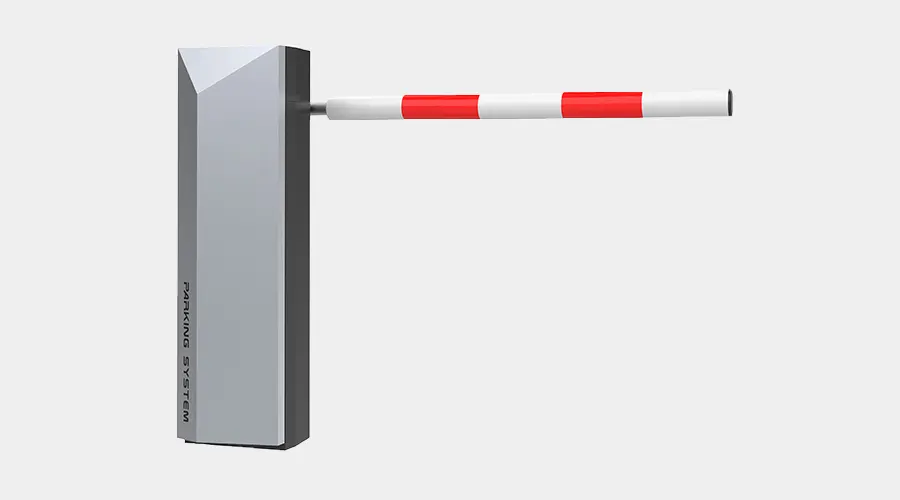
Traditional gates rely on a large spring to counterbalance the weight of the arm. While effective, springs wear out, fatigue, and limit the maximum acceleration of the arm.
This new generation of gates utilizes a precision harmonic reducer and a high-performance servo motor. This design eliminates the need for a physical spring.
Thanks to this technology, the speed restrictions of the past have been broken.
When selecting a barrier gate, you are no longer strictly bound by the “Longer = Slower” rule if you are willing to invest in newer technology.
Would you like me to help you draft a specification sheet comparing the costs between traditional spring gates and the new harmonic gates?


