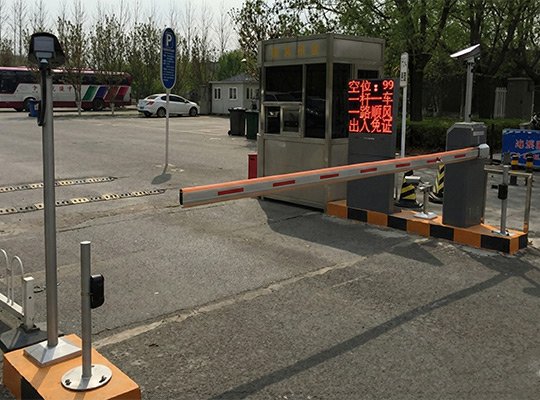
If you work in the access control industry like we do at ACCESS TECH, you know the nightmare scenario: a barrier gate arm coming down on a client’s luxury sedan. It’s not just about the damage; it’s about liability and safety.
Choosing the right safety device—specifically between a Vehicle Loop Detector and an Infrared Sensor (Photocell)—is the most critical decision you’ll make during installation. I’ve seen projects fail simply because the wrong sensor was chosen for the environment.
Today, we are going deep into the PD-132 Loop Detector and the IR33 Infrared Sensor—to give you an honest, experience-backed comparison.
1. Technical Principles: How Do They Actually Work?
To make the right choice, you need to understand what’s happening under the hood.
The Vehicle Loop Detector (PD-132)
Think of the loop detector as a giant metal detector embedded in the road. It relies on inductance.
The Setup: A wire loop is buried in the driveway. The PD-132 detector monitors the inductance range (typically 50-1000uH).
The Trigger: When a car (a large metal object) drives over the loop, it changes the frequency of the magnetic field. The PD-132 detects this shift and triggers a relay (Pulse or Presence) to keep the gate open.
Smart Features: The PD-132 allows us to adjust the frequency (20KHz-170KHz) to prevent “crosstalk” interference if two loops are installed close to each other.
The Infrared Sensor (IR33)
The infrared sensor is simpler; it’s an invisible tripwire.
The Setup: It consists of a Transmitter (Emitter) and a Receiver. The emitter sends an infrared beam (1.92KHz frequency, 940nm wavelength) to the receiver.
The Trigger: As long as the beam is unbroken, the gate closes. If a car—or a person—breaks that beam, the relay triggers to stop or reverse the gate.
2. Installation: The “Sweat Equity” Difference
This is where the debate usually heats up. The installation requirements are vastly different.
Loop Detector Installation (The Hard Way)
Installing a loop detector like the PD-132 is a construction project. You cannot just “stick it on.”
Cutting the Road: You need a cutting machine to slice a slot 30-50mm deep and 4mm wide into the concrete or asphalt.
The Geometry Matters: You can’t cut 90-degree corners. You must cut 45-degree chamfers (oblique angles) at the corners to prevent the sharp concrete from slicing the wire insulation.
Feeder Wires: The wire running back to the detector must be twisted at least 20 times per meter to ensure signal stability.
Sealing: Finally, you have to seal the loop with epoxy resin or hot bitumen.
Pro Tip: If you skip the “twisted pair” feeder step, you will get false triggers. I’ve seen it happen a dozen times.
Infrared Sensor Installation (The Precise Way)
The IR33 is physically easier but requires geometric precision.
Mounting: You mount the receiver and emitter on the gate posts or walls. They must be at least 20cm off the ground.
Alignment: This is the tricky part. The emitter and receiver must be on the exact same horizontal line, face-to-face. If they are slightly off, the LED inside the receiver won’t go out, and the system won’t work.
Wiring: You just need a 12-24V power supply and signal wires.
3. Pros and Cons: The Honest Verdict
Based on the technical specs of the PD-132 and IR33, here is how they stack up in the real world.
Vehicle Loop Detector (PD-132)
The Advantages:
Vehicle Specific: It only detects metal. This means a pedestrian walking past won’t unnecessarily trigger the gate (unless you want them to).
Weather Proof: Since the sensor is buried, rain, fog, or dust generally don’t affect the magnetic field.
Interference Filtration: The PD-132 has a “DIP 6” switch specifically to increase filtration against strong electromagnetic disturbance.
Automatic Sensitivity: If a high-bed truck passes, the PD-132 can boost sensitivity automatically to ensure it doesn’t close on the trailer.
The Disadvantages:
Installation Effort: Cutting concrete is loud, dirty, and permanent.
No Pedestrian Safety: If a child stands on the loop, the gate will not know they are there (because they aren’t made of metal).
Metal Interference: Underground pipes or reinforced concrete can impact the loop’s inductance.
Infrared Sensor (IR33)
The Advantages:
Universal Safety: It detects anything that breaks the beam—cars, people, dogs, bicycles. This makes it safer for mixed-use areas.
Cost & Labor: Much faster to install. No road cutting required.
Range: The IR33 covers up to 15 meters, which is plenty for even the widest industrial gates.
The Disadvantages:
Weather Sensitivity: This is the big one. The manual explicitly states that the range can be reduced by 30% in bad weather like fog, rain, or dust.
Alignment Drift: If a truck hits the post or the ground shifts, the sensors can misalign, causing the gate to fail open.
Summary Table
Feature
Loop Detector (PD-132)
Infrared Sensor (IR33)
Detection Type
Metal (Inductance Change)
Physical Obstruction (Beam Break)
Primary Target
Vehicles only
Vehicles & Pedestrians
Installation
High Labor (Cutting Road)
Low Labor (Mounting & Wiring)
Weather Impact
Low
High (Rain/Fog reduces range)
Cost
Higher (due to labor)
Lower
Which Should You Choose?
If you are managing a high-traffic industrial site or a parking lot where only cars go, choose the PD-132 Loop Detector. Its ability to ignore environmental noise and filter disturbances makes it the robust choice for heavy-duty barrier gates.
However, if you are installing a gate at a residential complex or a mixed-use facility where people might walk near the gate, you must use the IR33 Infrared Sensor (or use it in combination with a loop). The risk of a loop detector failing to see a person is too high in these environments.
The best setup? Use both. Use the loop detector to open the gate for cars automatically, and the infrared sensor as a “safety beam” to prevent the arm from hitting anything—metal or flesh.
Need help configuring your DIP switches or calculating loop geometry? Contact the ACCESS TECH support team today.